Showing posts with label Boston Massacre. Show all posts

Thursday, July 24, 2014

Thinking about the impact of ventilation exhaust noise on Washington Mall...

... or Installment No. 3 in Targeting New Urban Fabric Restoration

We're going to try audio/video for the first time, because you really need to hear this one. So, here goes:


The Location: Washington Mall (28 State Street), Boston, MA.

The Story: This is actually part of two separate RTUF series. There's the one where we try to prime the pump (indicated above), and also where we observe that relatively small changes can make substantial differences. There is no question that Washington Mall, the less-than-perfect pedestrianized stub-end of Washington Street that resulted from urban renewal lo those many decades ago, is substantially less than it should be, especially considering its location at the very heart of downtown Boston and, if you trace it all the way back, the center of the old Town of Boston. It's directly across the street from the Old State House/Boston Massacre site marker (major attractions on the Freedom Trail), and down a short block from City Hall. There should be more going on here than there is.

And so, dear RTUF Nation, you may wonder why this is? It seems that part of the problem is sub-par urban design at 28 State that placed a relatively dead face to the mall side of the building. This is a condition exacerbated after 9/11, when heightened security measures went into place for high-rises and the number of entry points to most buildings was significantly reduced. Another part of it, I do believe -- and I hope you agree after seeing and hearing the video -- is that a substantial and substantially loud HVAC exhaust vent was placed in the ceiling of the arcade at 28 State and, to make matters worse, that vent is now knocking and pinging on top of being loud. It is a significant deterrent to sitting/standing/trying to carry on a conversation in a location that would otherwise at least have a fighting chance of being comfortable. The Ames Hotel, which came in a few years ago to the then-empty Ames Building, tried to put an outdoor patio at this location and spent what appears to have been a fair amount of money furnishing it. But that failed fairly rapidly and the patio is now completely unused. I strongly suspect that the noise from this exhuast vent was a substantial part of the reason why the patio didn't work.

I won't attempt to sort out the issues here -- whether 28 State's vent is violating the City's noise ordinance or whether the Ames Hotel folks should have tried to reach a deal to quiet the thing -- but the lesson I want to draw is that the urban ensemble required to create great places is sometimes a pretty delicate thing. This is a space that, given the surrounding foot traffic, should be lively. Instead, because of the overhead sound pollution, it just can't get there. It's another example of the ways in which we have collectively allowed ourselves to degrade the public realm. Part of the solution going forward has to be that we pay more attention to these kinds of details so we have an urban fabric that is comfortable as well as functional.

The RTUF Sketch:


Blog Post No. 2014-8

Friday, November 25, 2011

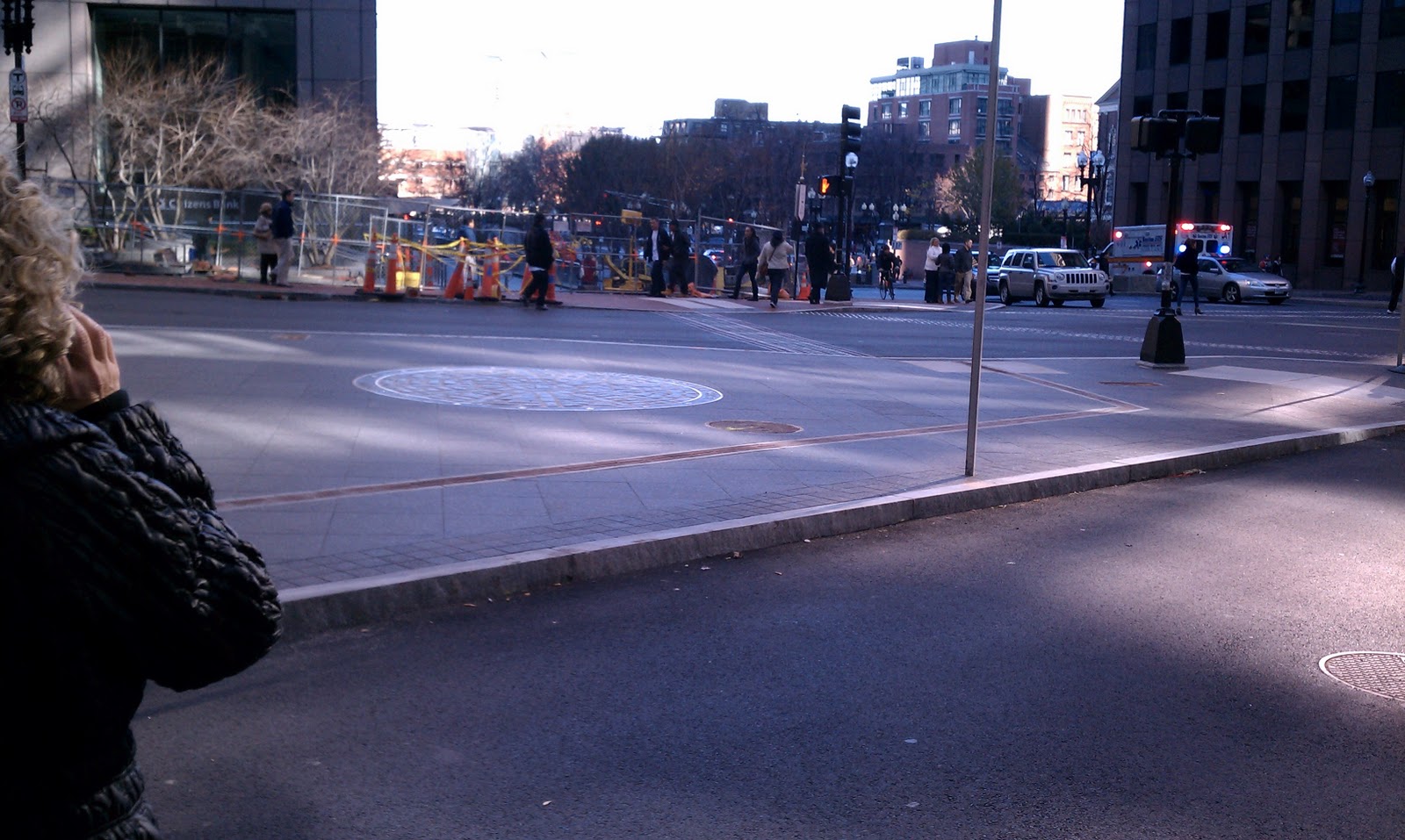
Blog Post No. 2011-19: The Boston Massacre Site Marker finally gets some respect...

...and we all get a much better intersection at State, Court, Washington, Devonshire, and Congress Streets.

1. Looking toward Dock Square, across the site marker and State St.

2. The restored site marker, indicating the date of the massacre.

3. Looking up Devonshire St., corner of the Old State House at right.

4. Looking from the opposite vantage point, across Congres and down State St.

The Location: State, Court, Washington, Devonshire, and Congress Streets, Boston, MA (Map).

Year of Urban Fabric Restoration: 2011.

The Story: We last focused on the positive influence of thoughtful intersection improvements early last year in discussing Alexander the Great Square in Roslindale, a place admittedly somewhat on the periphery of the city. We're now looking at the very heart of Boston - directly in front of the Old State House (built on the site of the original Town House) at the intersection of five different streets - and near the site of the Boston Massacre, one of the defining moments in the run-up to open hostilities in the American War for Independence. The Wikipedia entry linked here recounts the devolution of a relatively routine encounter in the street into calling out a small contingent of armed troops, to taunts and snowball/rock throwing by the frustrated local citizenry at the symbols of imperial power to the climax of the event - the undisciplined firing of weapons by the provoked soldiers into an unarmed crowd, resulting in the death of 5 Bostonians. It never ceases to amaze me that John Adams led the defendse of the 8 British soldiers who, after an investigation by the colonial authorities, were charged with murder - and managed to get 6 of them (including the corporal in charge, who had never ordered his contingent to fire) acquitted and 2 convicted of the lesser charge of manslaughter.

The site marker's location is somewhat inaccurate - it seems clear from the available record that the incident itself took place in front of the colonial-era custom house, which was down State Street (then King Street), closer to the harbor. But there is no doubt that the recent improvements at this intersection make it both a more fitting setting for the marker (which has itself been given a typically understated old school-Boston upgrade with the date and title information around the outside) and a much better pedestrian environment. I'm not sure when the area took on the God-awful street design that pushed a direct access lane from Congress Street to Devonshire Street within just a couple of feet from the Old State House's corner, though based on the Bromley Atlas plates available online, it was definitely after 1938. That seems about right to me. Most of the really bad street design/traffic engineering in the country took place in the immediate postwar period, when it seems the thought was that everything should be made easier for automobiles, flying cars were just around the corner and we certainly weren't going to be needing much in the way of walkable urban areas - at least at the ground level - in our bright, Jetsons-like future. So, what was the big deal if you isolated the Boston Massacre site marker and utterly stripped it of its context by sticking it in the middle of a pork-chop shaped traffic island? It wasn't long for this world anyway.

Credit: The Boston Globe.

And as is the way with capital improvements, this bad decision-making proved long-lasting. It's been several decades now since Boston embraced its long and storied history as something that was important, worth preserving, and (above all) marketable. Even so, it wasn't until the MBTA decided to renovate State Street station, which underlies much of the intersection, about 5 years ago that the City was able to find the right opportunity to right this particular wrong and give everyone the opportunity to stop and reflect on this historic event without the fear of being run over at any minute. As someone who works in the building that looms, Vader-like, above the Old State House and thus comes through this particular part of Boston quite often, there is no question that this is a great improvement over the old layout, rationalizing the vehicular traffic pattern and expressing a clear preference for the huge volume of pedestrians - both residents and workers in Boston as well as our tourist friends from around the country and the world - who pass through here on a daily basis. It's just another example of small changes that are running in the right direction for a better experience for everyone who comes into contact with this city. More of this please.

RTUF sketch of the restored urban fabric: You'll have to forgive your correspondent for failing to property title the sketch. I've discovered since doing and scanning this sketch that the actual Boston Massacre Memorial is on Boston Common. This is only the site marker. - MJL

Monday, February 28, 2011

Blog Post No. 2011-3: Four Green Fields at One Boston Place...

Because really incremental improvements are sometimes worth looking at if the baseline was really bad.

(1)
(2)


(3)


(4)

(5)


(6)


Photos: Taken with my new Droid Incredible by HTC (yes, I know it's already a couple of steps behind the newest-latest, but that's how it's done here at RTUF) smart phone, so the pix aren't quite as nice as they could be: (1) Looking at the front of the public house from the sidewalk on Washington Street; (2) A bit longer view, from across Washington Street; (3) The edge of the pub and the main building entrance for One Boston Place (aka, 201 Washington Street); (4) Looking toward the end of Washington Street, with the Ames Building and the Washington Place pedestrian mall and the Old State House; (5) Main entrance from across Washington Street; and (6) A view up Court Street with the Court Street entrance and the Boston School Committee building beyond.

Location: One Boston Place (201 Washington Street), Boston, MA.

Year of Urban Fabric Restoration: 2011.

The Story: So, in the interest of full disclosure, this is where your faithful RTUF correspondent works (not in the pub, but in the building above). This building -- which I refer to as the "big black building with the black box on top across the street from the Old State House" whenever asked -- had to, in its original configuration, have been one of the most uninviting buildings anywhere in Boston. Designed by Pietro Brulleschi and developed by Cabot Cabot & Forbes as the new headquarters for The Boston Safe Deposit and Trust Company in 1970, the old street level exterior resembled nothing so much as a crypt or a bunker. It was one forbidding building, let me tell you, and it sent out the message that no one need come near it who didn't have some serious business to transact inside. The buidling entrances on both Washington and Court streets were set within low-slung, horizontal brown granite blocks with no canopies and almost no way to see inside the building and afterthought planters and benches on the residual space between the building and street on both sides. Bad, bad, bad, and especially so considering that the Old State House across Washington Street has a rich history as the oldest public building in Boston, the seat of the old colonial government, the new state's seat of government until Bulfinch's New State House was built on Beacon  Hill in the early 19th century, and the site of the Boston Massacre in March of 1771.

Perhaps the acquisition of The Boston Company by Mellon and Mellon's merger with BNY in the 1990s and early 2000s led to a renewed look at the buidling and its potential to draw tenants on its own as the headquarters footprint was reduced. Whatever the cause, in the early 2000s, the building's owners started a program of making the ground level more transparent and comfortable (hence the glass walls and canopy) and improving the public space between the building and the adjoining streets. The final step in that rethinking and reimagining is the restaurant space simply by putting windows where formerly there were blank walls and seeding a patio where none was really considered before. This part of the plan has finally borne fruit in the opening of Four Green Fields, an Irish pub and restaurant, just this month. So far, the pub is drwaing crowds and come spring and summer after this classic New England winter, it seems reasonable to expect patio seating in what is a shady spot given its northeast exposure. With the restoration of the Ames Buidling at the end of Washington Street and the installation of a decidedly upscale patio area there, it is fair to say that this end of Washington Street hasn't had so much to recommend it to the casual visitor in a long, long time.

RTUF Sketch of the Restored Urban Fabric: The hatched area here is the street level extension of the building outside of the footprint of the office tower above. We'll report back in the spring/summer on whether the patio scene actually develops.

FINAL RTUF Note: Over the weekend, we went over the 2,000 visit mark! Many thanks to everyone out there in RTUF Nation who has come and taken a look and, even better, commented. - MJL